
TUESDAY, JULY 11
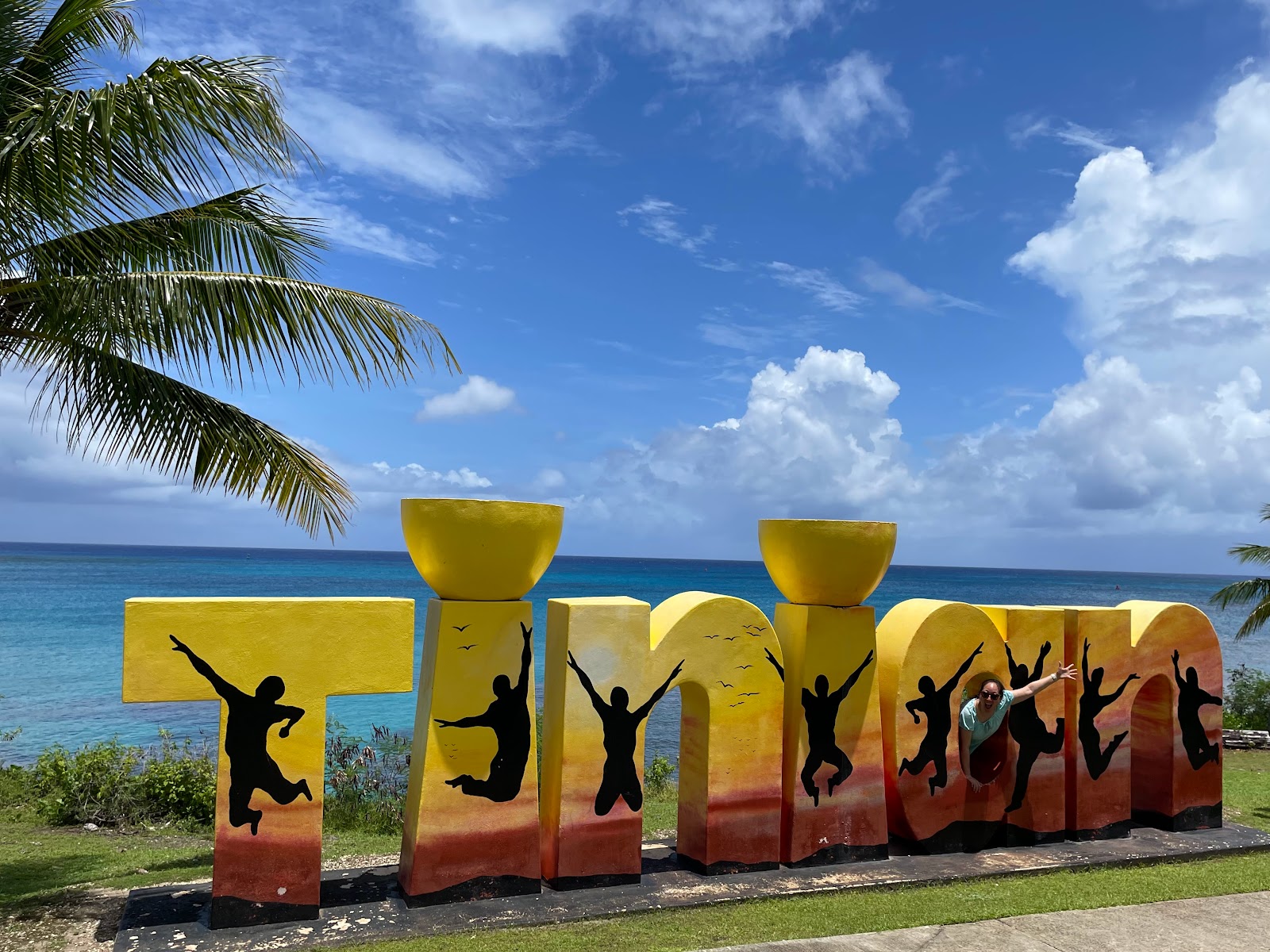
About 5 miles from Saipan lies Tinian, a small Mariana Island steeped in WWII history. Since we had the day free, Erin and I decided to take a day trip over to explore. We messaged with teacher Aileen who was also interested in going, and at breakfast, we ran into teacher Emily from Memphis (who I’d met several years ago at the Most Southern Place NEH seminar) and she joined in as well.


From the maps, all the sites looked straightforward and easy to find, with very few streets on the island. But the rental agent warned us: only drive on the main roads, and we’ll definitely want the truck. Not the SUV, not the car – the truck. So for the day, we got a large pickup truck… and were so glad that we did – the roads were so overgrown!
 |
| I don’t even recognize all those languages… ! |
Because of the vast quantities of unexploded ordinance, the US decided to essentially abandon the island, and nature has reclaimed virtually all but a small community on the southern tip of Tinian. Erin said it best when she compared our day to being in a real-life Jumanji game – flying in the tiny plane, tromping through the jungle, and navigating through the overgrown brush!
 |
| 🎵”They say the neon lights are bright on Broadwayyy…”🎶 |
We headed north on the island’s main thoroughfare, Broadway, which very quickly became a potholed, overgrown dirt track. During WWII, Tinian was a bustling hub of activity. It was such a change seeing it now, since it was mostly overgrown and abandoned – but it was so peaceful, quiet, and clean! The trails to historic sites were fairly well maintained, and we were surprised how few bugs we encountered.
 |
| Limestone caves are found all over the Marianas |
Our first stop was to the Japanese Defensive Caves, built into the limestone cliffs to shelter Japanese soldiers in early 1944. American troops attacked cliff caves like these with grenades and flamethrowers during the battles all over the Marianas Islands.
 |

From there we drove over to the North Field, the major US airfield of WWII and the base for the B-29 superfortress bombers.

Before the US recaptured the island, Tinian was a Japanese airfield, known as Ushi Field. Many of the existing buildings were originally built by the Japanese, including air raid shelters built with reinforced concrete which also provided protection from gas attacks.
 |
| A peek into the shelter |
 |
| Japanese Air Administration Building |
 |
| North Field, Tinian, 1945 |

We drove down Runway Able, where early in the morning on August 5, 1945, the B-29 bomber Enola Gay took off for carrying the 4-ton uranium bomb “Little Boy” – the first atomic weapon used in warfare. At the far end were two loading pits, Atomic Bomb Pit No. 1 for “Little Boy” and Pit No. 2 for the plutonium bomb codenamed “Fat Man”. Because the bombs were too big to load onto the B-29 Superfortress Bombers the regular way, the pits were dug so the plane could park directly above it with the bomb bay doors open, and the bomb was winched into the belly with hydraulic mounts.
 |
| Atomic Bomb Pit No. 1 |
 |
| The crystal clear waters of Taga Beach |

At the furthest south-eastern point on the island is Suicide Cliff, where during the Battle of Tinian in late July 1944, hundreds of Japanese citizens and soldiers jumped to their deaths. There are several shrines to commemorate those that died. These suicide cliffs, that exist also on Saipan, highlight the cultural difference between Eastern and Western philosophies. For the Japanese, it was a dishonor to surrender, and the Emperor and Japanese Army encouraged civilians and soldiers to take their own lives. It’s a beautiful yet somber spot.

For lunch we stopped at JC Café (as recommended by our car rental clerk) in the little town of San Jose, and it seems like it is the best (and possibly only) restaurant on the island. It was actually quite good, and the people there were so nice and friendly! I even bought a jar of their chili sauce, made with the locally grown Tinian peppers.

Near JC was the House of Taga, the remnants of a prehistoric megalithic structure said to be the home of the 10 ft. tall giant Guamanian chief Taga. Because of his strength, his own father tried to kill him so he jumped off a Guam cliff and landed on Rota, where he lived and married. He then traveled to Tinian, where he impressed the chief so much with his feats of strength that Taga was named chief of the island. He built himself a home, the remains we see today. Of the original twelve 15-ft tall latte stone pillars, only one remains standing.

According to legend, Taga’s wife had 12 children, but when one son showed greater strength than his father, Taga got jealous and killed him. His youngest daughter killed him in retaliation, then died of grief. The 12 latte stones contain the spirits of his 12 children, which can only be released when the latte stone falls; the last remaining standing stone contains the spirit of the murderous daughter.
 |
| The first recorded illustration of the House of Taga, by British Commodore George Anson, 1742 |
 |
| Do NOT put a scratch the car, they said… |
We took 8th Ave (and a slight detour to Riverside Drive due to a closed road – it started raining and Erin had to open two cattle gates along the VERY overgrown and narrow trail) back up to the SeaBee Memorial.

The Seabees were the Navy’s Construction Battalion, who quickly finished the North Field construction in 45 days to ready it for the US bombers.

The four of us originally were on the same flight, but the chief of staff of the mayor of Tinian missed the call to get on the plane, so he bumped Erin off our flight and onto the next. They’re clearly very casual around here – he ran out onto the tarmac yelling that they forgot him, and the man helping us board took one look at him and said, “Oh, shit.” Not really what you want to hear from the airport official…

He was a wealth of information about the history of Saipan and about some of the politics and economic stories of the CNMI, and so friendly! Plus, he seems to be related to pretty much everyone else we met on the island… such is small town life!
Overall, we loved our visit to Tinian. It was a surprising adventure, historically meaningful but a beautiful, sleepy little island that I would encourage anyone to visit.
One response to “Marianas Part II: Tinian – A Hidden Gem”
Is Tinian Japanese now? And you did all that in one day, amazing. I learned a lot, thank you