
In the early 1960’s, my mom migrated from Taiwan to Colombia to work in an upscale hotel in downtown Bogotá. Almost two years later she moved to the United States to marry my dad – and never looked back. I remember in high school asking her whether she wanted to visit, but back in the 80’s and 90’s, Colombia definitely was NOT the place one went for tourism. So this past Thanksgiving, I invited my parents on a Colombia/Panama Nat Geo Lindblad expedition, traveling the Caribbean coast from Cartagena through the Panama Canal. We’d go a few days early to visit Bogotá, to see if my mom recognizes any part of the city she lived in 60 years ago. (Spoiler alert – she doesn’t.)
Medellín Cartel founder Pablo Escobar was once the wealthiest criminal in history with a net worth of around US$70 billion dollars in today’s money. He had his own zoo with 4 hippopotamuses – and hippos, while mostly vegetarian, are extraordinarily territorial, highly aggressive, and are among the deadliest animals in the world. When Escobar was killed in 1993, the hippos were too expensive to deal with, so they were left to wander his estate. They have now multiplied to a population of over 160 “cocaine hippos” whose range has spread into the neighboring territories. These hippos are feeding heavily on plants, displacing native species, and even attacking humans. Just this month, the Colombia government began a massive plan to control the hippo population.

The capitol city of Colombia, Bogotá, is situated on a high plateau in the Andes mountains known as the Bogotá Savanna. It was founded by Spanish conquistadors in the 1530s after their expedition conquered the indigenous Muisca people. Basically, a bunch of outsiders came in search of El Dorado – the fabled city of gold – and even though they didn’t find it, they decided to stay and take over.
We arrived late at night in Bogotá after a long day of travel but made it safely to Casa Legado. It is a lovely boutique hotel, with fun and funky decorations and hot water bottles warming our beds! Breakfast was delicious, and mom said the Colombia coffee was fantastic – I even tried some, even though I don’t normally drink coffee. (The verdict: tastes like coffee!)
 |
| Fallen Jesus |
 |
| One of the stations (don’t ask me which one) |
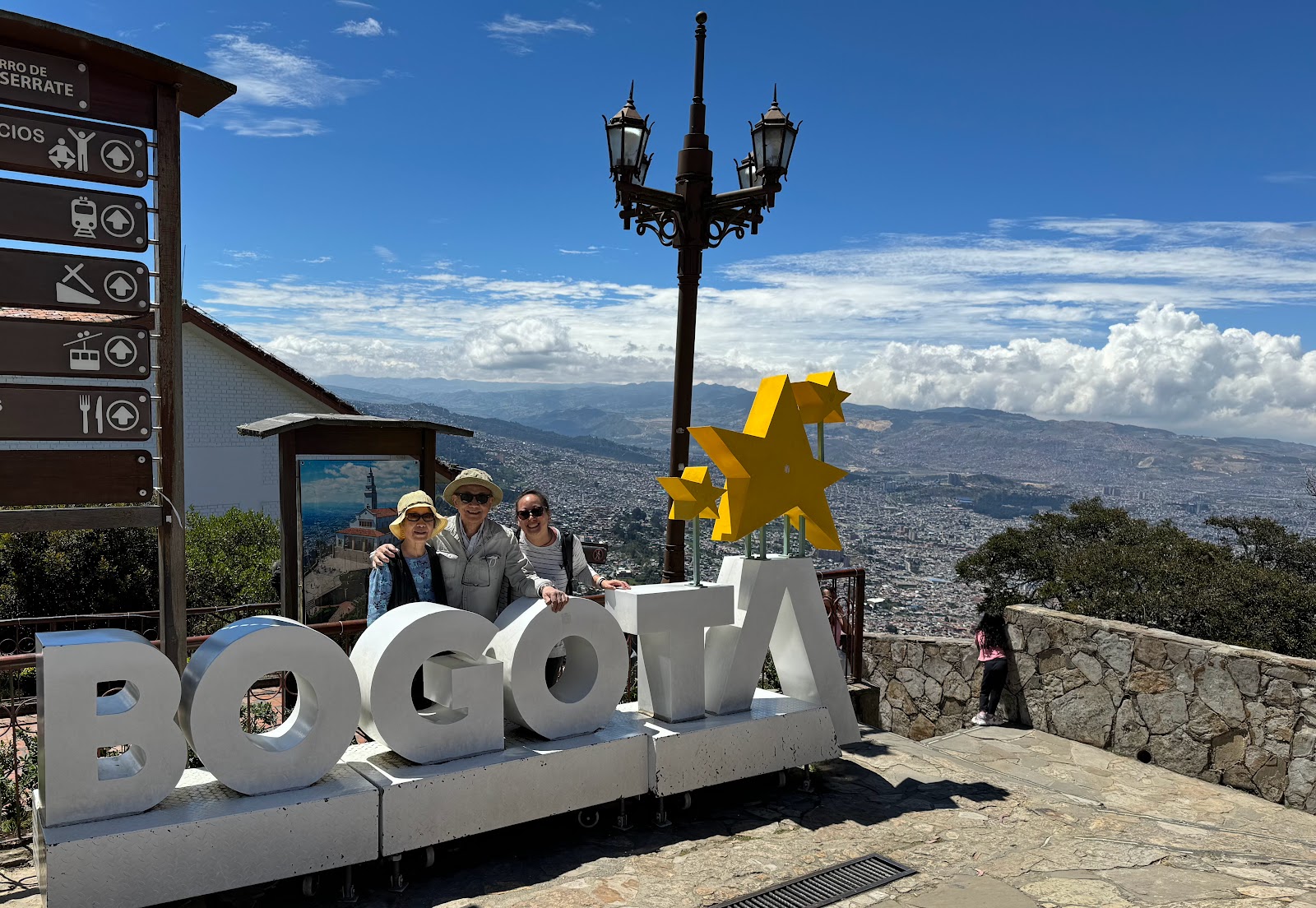
We took the funicular ride up, then walked the path that features statues of the Stations of the Cross. As a totally non-religious person, I had no clue this was a thing! Basically, the stations tell the story of the crucifixion of Jesus as he travels up to Mount Calvary, through a series of statue vignettes. Within the Church is a statue of Jesus known as the Fallen Lord, posed in a rarely depicted collapsed state. But the main highlight of the visit was the panoramic view of the Bogotá. We picked a gorgeous day, with blue skies and a clear view across the city (kind of awesome, considering we expected rain for our entire visit!)
 |
| It’ll be cold and grey and rainy, they said… |


We then walked into La Candelaria, seeing the many colorful murals covering the buildings.
We stopped at Plaza del Chorro del Quevedo, which was supposedly the place where Bogotá was founded in 1538 by the Spanish conquistador Gonzalo Jimenez de Quesada. (Of course the head of the indigenous Muiscas hung out there long before the Spaniards got there, but hey. Who’s counting?)

 |
| I mean… just LOOK AT HER! 🤣 |
Our next stop was the Plaza de Bolívar, the main square surrounded by the city hall, National Capitol, Palace of Justice, and Cathedral of Bogotá. It’s a huge concrete space that is the site for many gatherings, and a huge flock of pigeons happily gather, fed by tourists. At the center of the plaza stands a statue of Simón Bolívar.

Did you know? Simón Bolívar was the Venezuelan leader that freed Colombia (along with Venezuela, Ecuador, Peru, Panama, and Bolivia) from the Spanish Empire. Nicknamed El Libertador (the Liberator), Bolívar is such a key historical figure that pretty much every major city (and even many of the minor ones) in all those countries have a plaza or park honoring Bolívar.

The last stop of the day was the Gold museum, which had a fascinating display of pre-Colombian treasures as well as exhibits on metallurgy and symbolism. Colombia is famous for its gold, particularly because the famed city of El Dorado was supposedly located somewhere near Bogotá. According to legend, a Muisca tribal leader was witnessed covering himself with gold dust and throwing gold and treasures into Lake Guatavita as an initiation rite. This display of excess caused the witnesses to believe they must have a city of gold, enough that they could just throw it away. The most famous pieces in the Gold museum depicts this legendary raft.

Our second full day started with another delicious breakfast at Casa Legado followed by a trip just outside of the city to Zipaquirá. Along the way, we made a quick stop at the Puente del Común in Chia, original Spanish bridge over the River Bogotá. It was built in 1796 and was once the only way to cross the river into the city.

In Zipaquirá, we visited the famed Salt Cathedral, built 200 meters underground in an old salt mine. The rock salt found here was deposited around 250 million years ago when the area was covered by the ocean. The deposits were then uplifted when the Andes mountains were formed during the breakup of Pangaea. These mines were first used by 5th century indigenous Muiscas to collect the rock salt.
 Before the original underground church was built, there was first a sanctuary where the miners gathered for daily prayers to ask for protection. The original Salt Cathedral was completed in 1954, and a new cathedral was inaugurated in 1995. During the walk down, there are 14 small chapels representing the stations of the cross – which I now know all about! The current Salt Cathedral consists of three huge chambers with attached galleries. The three naves represent the birth, life, and death of Jesus – the cross on the main altar is the largest underground cross in the world.
 We made it back to the hotel a little after 2, which gave us a leisurely afternoon to relax and enjoy the gardens at Casa Legado. We had tea while we played mah jongg in one of the courtyards (where I promptly lost one card before we even started when it fell through the crack between the wood slats. Le sigh.)